

T-Mark – Fully Automated Laser Tire Marking System
Industry Standard in Tire Marking
With around 200 systems installed worldwide, our fully automated T-Mark tire laser marking system and the handheld T-Mark Compact system are in daily operation at leading tire manufacturing facilities across Europe, the Americas, and Asia. These systems are trusted by virtually all major tire makers and have already laser-marked more than one billion tires globally.
Highly flexible, T-Mark systems can engrave bitmaps, DXF graphics, alphanumeric characters, and 2D matrix codes onto tire sidewalls – covering diameters from small 14-inch passenger tires up to large 25-inch super-single truck tires. The systems support random-order processing and stand out with short cycle times, robust engineering, integrated quality control, and an intuitive interface for both operation and maintenance. These features have established T-Mark as the industry benchmark for laser-based tire marking.

Laser Marking
Built for continuous operation – reliable even under high production loads.
Adapts automatically to different tire types and recipes.
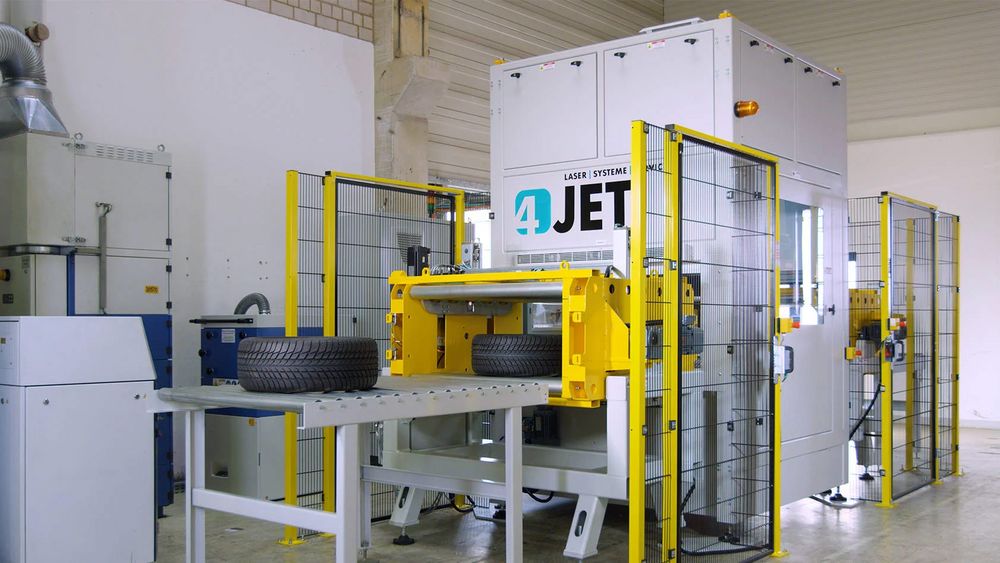
Class 1 laser enclosure protects operators and meets top safety standards.
Best-in-Class Performance
Cycle time depends on the size and complexity of the engraving as well as the validation steps selected before and after marking. With one-sided engraving, the system can usually mark over one million tires per year.
The contact-free laser process ensures gentle handling of the tire surface and keeps wear-part costs to a minimum. When maintenance cycles are adhered to or operated under a 4JET maintenance contract, the system typically achieves over 95% uptime, requires minimal consumables (mainly aspiration filters and cleaning agents), and features low energy consumption.
The system is fully automated. With the optional auto-teach feature, even new tire models can be introduced without manual setup - eliminating operator involvement during teach-in. Daily operation is straightforward and requires minimal training. The T-Mark’s core system has a compact footprint of just 2 m x 2 m; the total system size (including e-cabinet, aspiration unit, flippers, and access area) is typically around 16 m², depending on the individual layout.
Safe, Flexible, and Proven Laser Marking
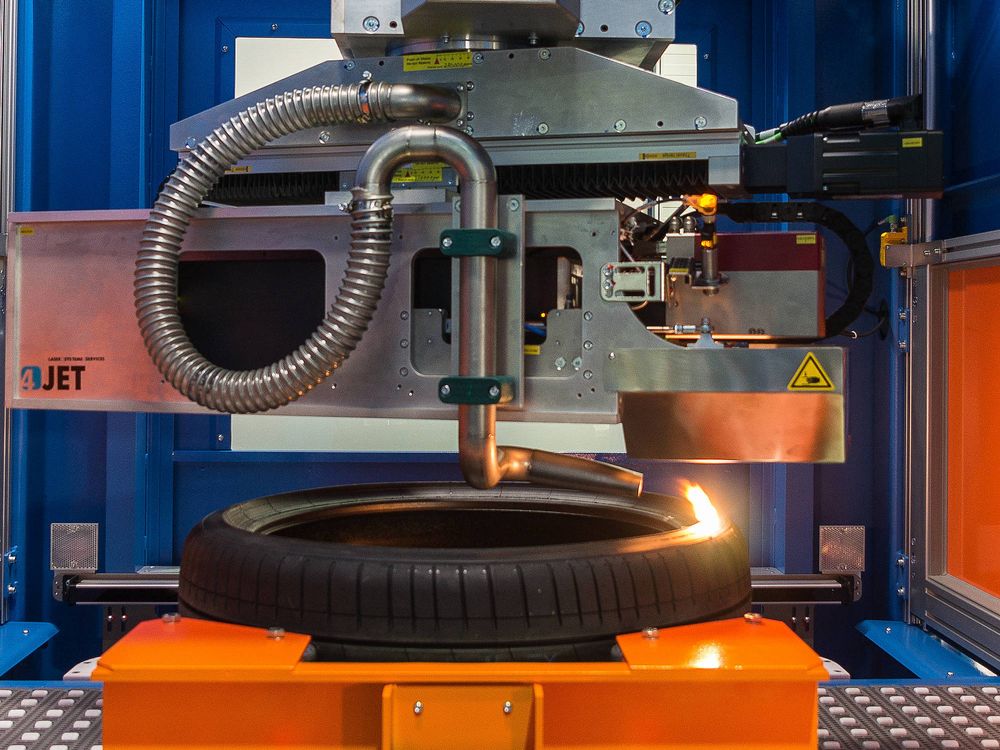
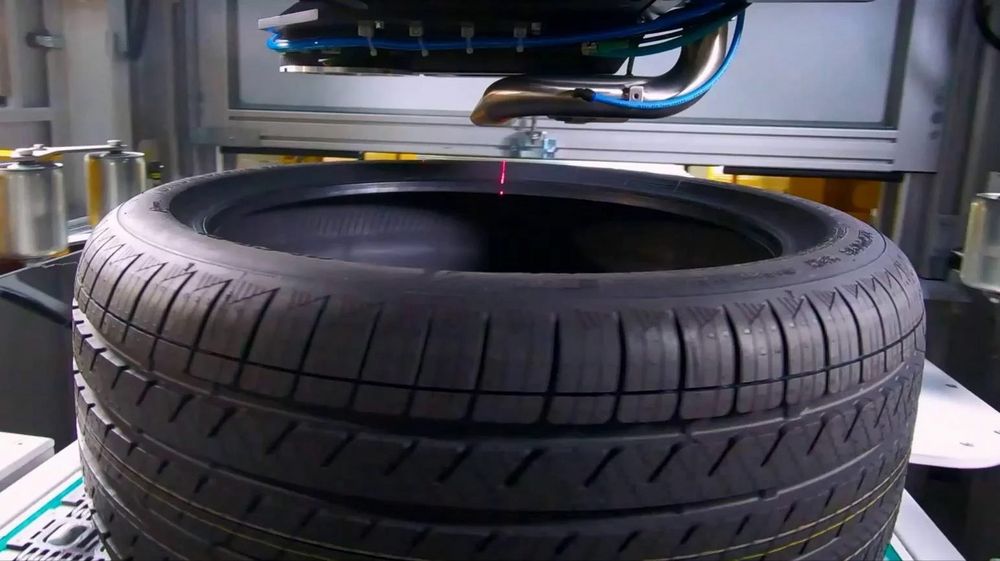
After automatic tire feed-in and recipe handover, the tire is positioned beneath the rotating laser processing head. The sidewall is scanned, and the laser head then precisely moves to the marking area as defined in the tire-specific recipe.
Based on this predefined recipe, the system automatically executes all required steps: pre-validation routines, one or more marking passes, post-validation procedures, and – if necessary – tire flipping. All relevant process data is logged and transferred to the customer's MES system after tire feed-out.
The laser process uses a sealed CO2 laser and is fully enclosed in a Class 1 laser-safe system, meaning it poses no laser hazard during operation and does not require additional safety measures for operators.
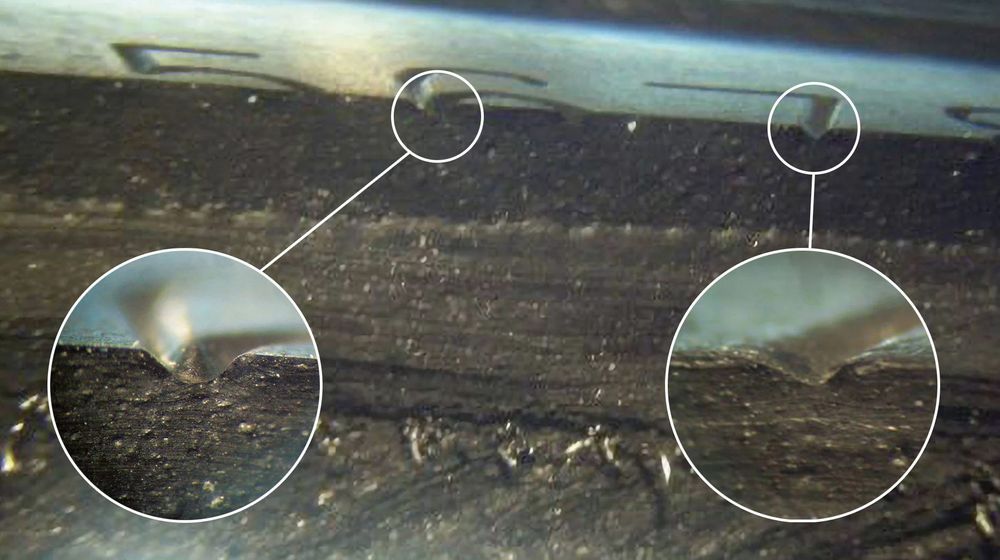
The marking is performed via laser ablation, which vaporizes the top layer of the rubber surface into a carbon-laden smoke, safely extracted by the integrated filtration unit. The laser energy is applied locally and only to the surface, ensuring high energy efficiency and preventing damage to deeper layers of the sidewall. In addition, the Gaussian-shaped laser beam creates smooth and rounded edges in the engraving, minimizing notch effects and mechanical stress on the tire structure.
Key Features
Our market-leading tire marking technology comes with a comprehensive set of advanced features designed to ensure consistent quality, high efficiency, and highly reliable operation. A state-of-the-art sensor system continuously monitors performance and detects deviations from the defined process.
An intuitive workflow system allows users to easily create new tire recipes and process sequences, offering maximum flexibility to adapt the system to various tire types or specific MES requirements such as engraving type, position, or validation step combinations.
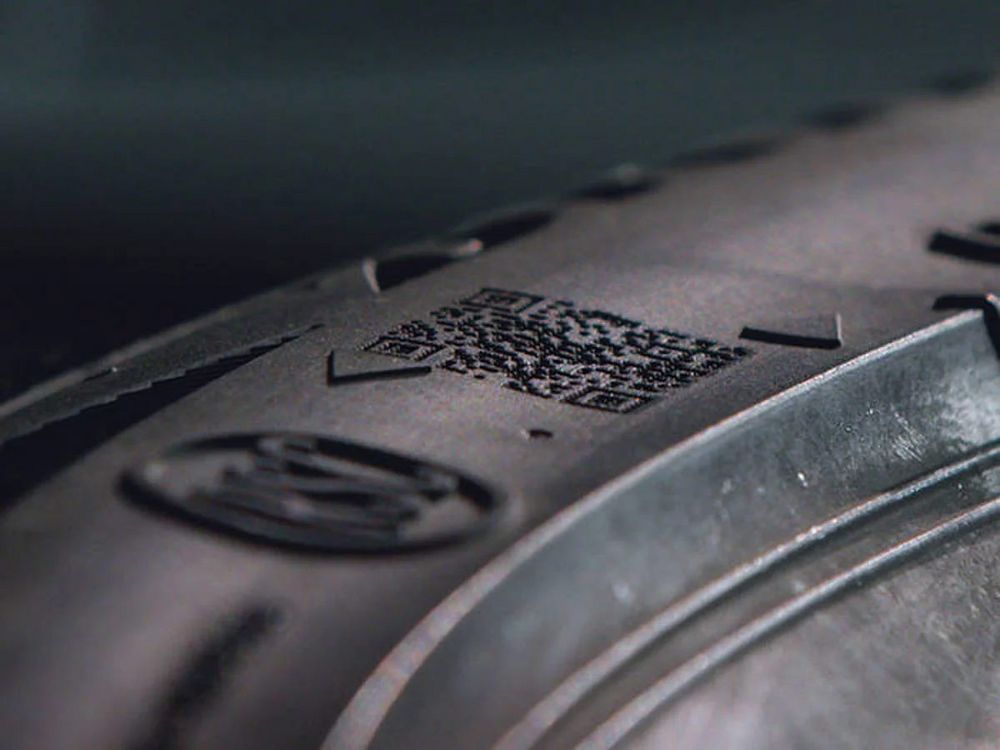
Before marking, the system can evaluate multiple potential engraving positions to avoid damaging existing color marks like balance dots. Markings can be validated using model matching or optical character recognition (OCR). The engraving quality of 2D matrix codes can be improved using projection correction to compensate for the curvature or angle of the side wall.
Areas of Application
The ability to engrave all kinds of logos, characters, numbers, or 2D matrix codes gives the T-Mark system a broad range of applications.
The engraving of logos and legally required symbols helps reduce inventory complexity and streamline tire production.
Fully automated laser marking of DOT date codes eliminates the need for manual slug changes in the curing press, offering significant economic and operational benefits.
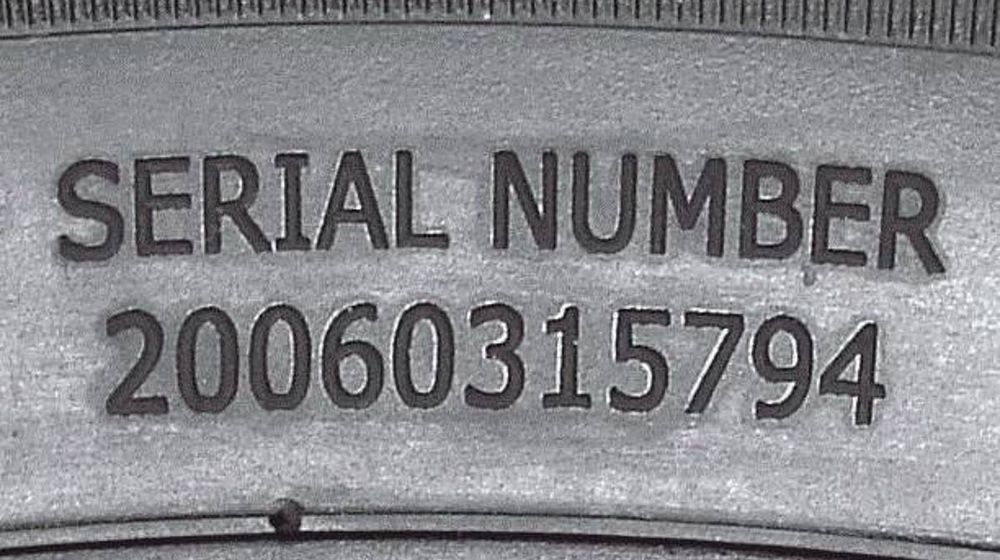
The use of unique 2D matrix codes is essential to meet future regulatory, and market demands while staying competitive. These codes enable seamless traceability throughout the entire lifecycle of a tire - from manufacturer to retailer to end user to disposer. They also improve efficiency across key processes such as production, warehousing, vehicle assembly, and maintenance. In addition, the T-Mark system is fully Digital Product Passport (DPP) compliant, enabling the digitalization of tires to support future EU regulations and sustainability goals.

International Intellectual Property for our T-Mark Technology
As a global leader in laser-based production systems, we invest a significant share of our annual revenue into innovation and technology development. To protect these investments, we maintain a robust portfolio of international intellectual property rights covering our systems, processes, and the products manufactured using them. A list of the most relevant patents and trademarks is provided below:
EP2905125, EP2977934, EP3147114, EP3238928, US2006/0161381, EP32818101, DE202014010855, DE202014011007, DE202017103420, US2018/00456111, EP3284586, CN107743450, KR10-2017-70367681, EP32978161, DE2905125, FR2905125, GB2905125, CA29993751, EP34486681, CA30223411, DE602014036348, CN1100146801, DE3147114, FR3147114, GB3147114, DE 20 2020 104 479.6, WO 2018/224601 (DE)1, WO 2018/224601 (KR)1, US 2019/01350115011
1 property right pending (status August 2020)
FAQ: Laser Tire Marking with 4JET T-Mark Technology
Laser engraving with T-Mark is highly flexible and enables the marking of 2D codes, text, serial numbers, logos, and much more. The marking is durable and provides permanent identification throughout and beyond the tire's service life. It enables unique identification and therefore complete traceability all the way through recycling.
Both passenger car tires (PCR) and truck and bus tires (TBR) with diameters of up to 1,350 mm and weights of up to 160 kg can be laser engraved. Four machine configurations are available to accommodate different tire sizes. The engraving process is fully automated, allowing the system to operate without operator intervention.
Depending on the application, various process control methods are available to ensure engraving quality. The most important include OCR post-validation and 2D code grading. After text and serial numbers are engraved, the content is checked for completeness and accuracy. For 2D codes, readability and code quality are also evaluated. This ensures 100% quality control.
Yes. The fully automated system is a Class 1 laser system and can be safely used in all production environments. During processing, the system remains enclosed and is monitored by a comprehensive safety architecture. No additional protective equipment is required because neither primary hazards from laser radiation nor secondary hazards from particles or gases can be emitted outside the system.
With nearly 200 systems installed worldwide, 4JET is the market leader, and the system is used by all major tire manufacturers. More than one billion tires have already been engraved.
The operating costs of our marking systems are low because no consumables such as ink, labels, or stamping dies are required. Total operating costs are less than €0.08 per tire engraving. Each additional engraving on the same tire costs less than €0.02.
Yes. Tire engraving with the T-Mark system is fully automated. Before different tire types enter the system, the corresponding barcode is scanned and the information is transferred to the customer's MES. Tire geometry, engraving type, engraving content, and all other relevant information are then sent back to the T-Mark system. After the tire is loaded, engraving is carried out at the position defined for that specific product.
Each new tire type must be taught once. It is then stored as a recipe and can be processed automatically in the future.
Maintenance in accordance with the maintenance schedule is recommended. Most maintenance tasks can be carried out by appropriately trained customer personnel. The laser itself is maintenance-free.
4JET operates service locations at its headquarters in Alsdorf, Germany, as well as in Atlanta, USA, and Shanghai, China. Various service levels allow customers to select a customized service package based on their specific needs.
In the event of a service issue, 4JET can be contacted directly via the hotline, which is available Monday through Friday from 8:30 a.m. to 5:00 p.m. In addition, support is available by email at service-tire@4jet.de.
A 24-hour hotline can also be provided. For this purpose, a dedicated service agreement can be concluded that differs from the standard service level. This includes, among other benefits, shorter response times and increased availability of the service organization for travel and on-site support.


