

Digital Product Passport for Tires
From Compliance Obligation to Competitive Advantage – with Laser-Engraved QR Codes
In the future, every tire placed on the EU market will need a durable, digitally accessible product identity – across its entire life cycle, from production and use to retreading and recycling.
With the EU Ecodesign for Sustainable Products Regulation (ESPR), the Digital Product Passport (DPP) is being introduced step by step for products on the EU single market – tires are among the six priority product groups of the first working plan.
The delegated act for tires is announced for 2027, and the first obligations are expected to apply from 2028. The drafts of the ongoing EU preparatory study already show very concretely which data the tire DPP will contain – and that marking at the level of the individual tire (item level) will effectively become a prerequisite for market access.
This page provides an overview of the requirements, the timeline and the implementation options – and shows why laser-engraved QR codes are the fastest and most economical route to DPP compliance.
An Urgent Obligation for Tire Manufacturers – with Opportunities
The tire DPP is not a distant future topic but an ongoing legislative process. In May 2026, the EU preparatory study (VITO, Öko-Institut, Ecomatters, Trinomics) published drafts with eight concrete DPP data categories – ranging from manufacturer information, substances of concern and recycled content to retreading data and a life-cycle event log. The horizontal DPP standards (EN 18216 ff.) have been published and harmonized since May 2026, and the EU DPP registry has been in operation since July 2026.
Timeline according to the draft status of the EU preparatory study, August 2026 – subject to change
Conclusion of the EU preparatory study
Delegated act for tires (indicative)
First obligations take effect
Phased extension of the requirements
For every tire manufacturer, this means a comprehensive cross-functional project: preparing data across IT, production and quality, selecting the data carrier and resolver infrastructure, integrating into running production lines – and doing so on a timeline that, experience shows, will turn out to be ambitious once the legal act has been adopted.
At the same time, the DPP is more than a compliance exercise. For the first time, it creates a standardized digital interface between the physical tire and connected product information – and thus the basis for:
Those who act early turn a regulatory obligation into a competitive advantage. Those who wait will implement later under time pressure – without any strategic room to maneuver.
Why the Tire Is a Special Case
Tires are among the most demanding product categories for digital marking – for three reasons:
- The product itself: Tires are sold without packaging or a permanent label. The tire itself is therefore the only place for a permanent DPP access point. Carbon-black-filled, electrically conductive rubber compounds and steel belts practically rule out smartphone-readable NFC technology; adhesive labels fail due to abrasion, deformation and detachment.
- Manufacturing: Vulcanization temperatures of up to approx. 180 °C, high pressures and rough handling considerably limit the choice of technologies that can be integrated.
- Use: Over the entire service life, UV radiation, chemicals, dirt and mechanical wear act on the surface – and the identifier must remain reliably readable after years in use and even after retreading. This very resistance to life-cycle conditions is explicitly required by the data carrier standard EN 18220.
Implementation Is the Real Project
Regardless of the technology chosen, the DPP confronts every manufacturer with four implementation tasks:
- Data availability and consistency: Production and life-cycle data must be reliably available at least at batch level and, foreseeably, at the level of the individual tire. Much information – a typical example is the DOT week code – is today only approximately known in the IT systems. Discrepancies between the physical marking and the digital data record are not permitted.
- Process for applying the data carrier: Whether RFID tag or marking – the data carrier must be integrated into existing manufacturing and finishing processes, often where space and cycle time are tight.
- Development effort per tire type: With embedded RFID tags, the integration has to be developed and qualified separately for each product variant – a considerable engineering effort with hundreds of SKUs.
- Re-homologation: Interventions in the tire structure can trigger new approval and homologation processes for each tire type, including OEM approvals.
In addition, there are decisions on identifier formats, coding standards (e.g. GS1 Digital Link) and resolver infrastructure – aspects that are often underestimated but determine interoperability and future viability.

UHF RFID: The Supposedly Set Solution
In its drafts, the ongoing EU preparatory study has so far assumed RFID as the standard data carrier, and the industry-driven CIRPASS-2 pilot also relies on this technology. UHF RFID (860–960 MHz, ISO/IEC 18000-63 / RAIN RFID) is used: a tag with chip and antenna is laminated into the tire structure during tire building – typically into the sidewall – and survives vulcanization.
The strengths of UHF RFID are undisputed:
- Identification without line of sight – even on a mounted, dirty wheel
- Bulk reading: many tires at once in a single reading operation
- High speed in automated B2B processes: logistics, warehouse, fleet management
These are offset by considerable hurdles:
- The integration requires tag embedding equipment in tire building
- Development and qualification work for every single product variant
- Extensive internal and external approvals up to OEM approvals
- An RFID tag is neither visible to end customers nor readable with a smartphone
- The EU preparatory study is currently explicitly examining whether RFID chips hinder recycling processes such as mechanical recycling, pyrolysis or devulcanization

The Alternative: Laser-Engraved QR Codes with SCANNECT
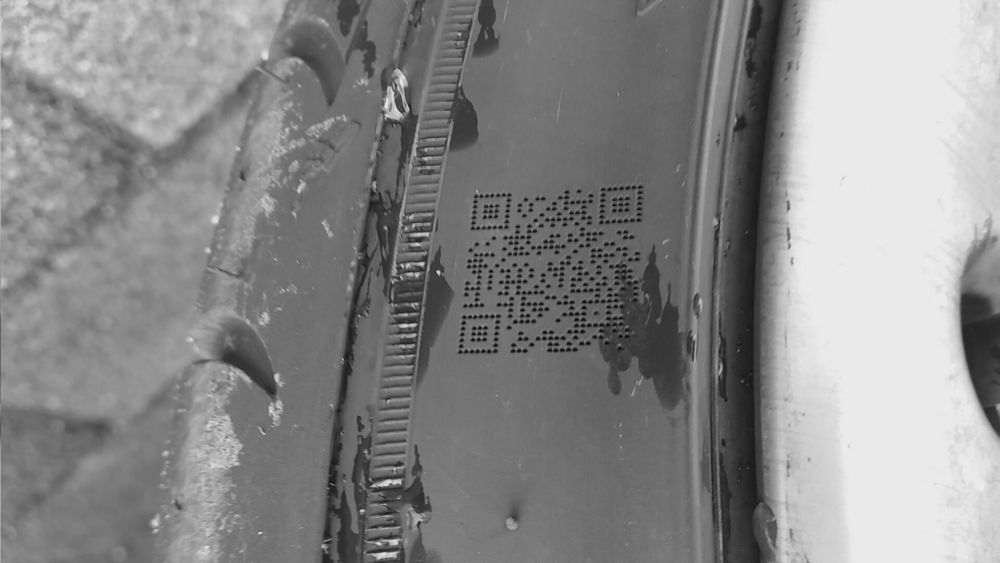
4JET SCANNECT engraves durable, high-contrast QR codes directly into the tire sidewall – using the same proven T-Mark systems with which well over one billion tires have already been marked worldwide. The code is recessed into the surface, therefore protected against wear, and structurally meets the durability requirements of the data carrier standard EN 18220 regarding abrasion and UV exposure.

Internationally recognized
As early as 2019, the US National Highway Traffic Safety Administration (NHTSA) cited 4JET as a stakeholder in its Report to Congress on electronic tire identification – including cost and durability data of laser-engraved 2D codes in practical use.

Compliant and practical
The harmonized standard EN 18220 explicitly recognizes optical 2D codes – QR and Data Matrix – as permissible DPP data carriers. The engraved code carries a unique identifier (e.g. according to GS1 Digital Link) and links via a resolver to the complete digital product passport – at the level of the individual tire, across the entire life cycle.
Your advantages with laser-engraved QR codes
- Significantly more cost-effective: no per-unit tag costs, no change to the tire structure – the cost per tire is many times lower than an RFID integration
- Radically simpler implementation: marking on the finished, vulcanized tire, without intervention in the tire building process or tire structure – hence no re-homologation per tire type and no development project per variant. Existing T-Mark systems can partly be retrofitted by an update
- End-customer interaction included: every modern smartphone reads the code without an additional app – the QR code is the universal, consumer-friendly access point to the DPP and at the same time the direct digital touchpoint to your own brand
- Industrial-grade: recognition rates above 99 % with industrial camera systems at usual conveyor speeds – also suitable for fully automatic inline tracking
- Available immediately: SCANNECT is commercially available today in the T-Mark systems

QR and RFID: Complementary Instead of Either-Or
QR codes and UHF RFID address different use cases within the same DPP ecosystem: RFID plays to its strengths in automated, reader-based B2B environments – the laser-engraved QR code is the universally accessible, visible and consumer-friendly identifier on the product.

For many manufacturers, the QR code is therefore the pragmatic first step to meet the ambitious DPP timeline: quick to implement, no product change, no re-homologation, fully compliance-ready – and particularly attractive if only part of the production is destined for the EU market, since no additional SKUs are created. In a possible second step, RFID can be added specifically where automated bulk identification delivers real process benefits.
Go Deeper: White Paper “SCANNECT – Laser-Engraved QR Codes for Tire DPP Compliance”
Would you like to dive deeper? Our white paper (September 2026, approx. 20 pages, English) summarizes the current state of regulation, standardization and technology:
- Legal framework and timeline: ESPR, delegated act, harmonized EN 18xxx standards, EU DPP registry
- Expected data content of the tire DPP: the eight data categories from the draft of the EU preparatory study – from substances of concern to the life-cycle event log
- Technical constraints of the tire as a product and their consequences for the choice of data carrier
- QR code technology in detail: capacity, error correction, GS1 Digital Link, payload optimization for minimal code sizes
- SCANNECT technology: superblack and black-on-white, process times, readability, system availability
- RFID vs. QR as complementary technologies and a realistic assessment of the implementation challenges
FAQ: Digital Product Passport for Tires
The delegated act for tires is indicatively scheduled for 2027; the first obligations are realistically expected to apply from 2028. The exact deadlines will be set by the legal act. Experience shows that after adoption only 18–24 months of transition time remain – too little to only start preparing then.
The current study draft foresees eight categories: product identification, manufacturer information, material compliance and substances of concern, environmental and circularity data, tire label data, retreading information, components that hinder recycling, as well as life-cycle status and event log. The list is not yet legally binding, but it clearly sets the direction and scale.
Yes. The harmonized European standard EN 18220 explicitly lists optical 2D codes – QR code and Data Matrix – as permissible data carriers, on an equal footing with RFID and NFC. What is required is resistance to life-cycle conditions such as abrasion and sunlight – a requirement that laser-engraved codes, integrated into the surface, structurally meet.
UHF RFID is excellently suited for automated B2B processes, but requires tag integration into the tire structure, development work per product variant, extensive qualification up to OEM approvals – and it cannot be read by end customers with a smartphone. Laser-engraved QR codes can be implemented faster, at lower cost and without any product change. Both technologies complement each other in a common DPP ecosystem.
The total cost of ownership of a SCANNECT marking consists almost exclusively of machine costs – variable costs are practically nil. With reasonable utilization and typical depreciation periods, the typical cost is below €0.10 per tire. If the system is additionally used for other markings (e.g. DOT week codes, logos, serial numbers), further cost savings result. We estimate the cost of applying an RFID tag to be in the same order of magnitude – but there are also variable unit costs for the tags, which are expected to remain above €0.50–1 per tag even at large volumes.
Independent reference: In its study “Electronic Tire Identification Study” (Report to Congress, 2019), the US National Highway Traffic Safety Administration (NHTSA) puts the total cost of RFID integration, according to tire manufacturers, at US$0.50–1.00 per tire – and the laser engraving of a 2D code at approx. US$0.08 per sidewall.
Yes – both technologies are highly compatible and complementary; we recommend using them together. There is no technical interference, but great synergies in the roll-out: SCANNECT enables a fast and inexpensive introduction, low ongoing costs and readability by end consumers. RFID adds automatic reading in the industrial environment, bulk reading capability and redundant information on the tire.
SCANNECT is a patented 4JET process for applying high-contrast, machine-readable QR codes to tire sidewalls. The code is applied by laser engraving with the 4JET T-Mark system onto the sidewall of the finished, vulcanized tire.
As a rule, no. SCANNECT is applied to the finished, vulcanized tire; a change of the tire construction or a new homologation is typically not required. In a few cases, adjustments to the sidewall design are necessary to meet the space requirements of the code.
Yes. This is made possible by the patented SCANNECT contrast enhancement: the laser creates a microstructure that traps incident light and makes the engraved modules appear significantly darker than the surrounding “tire black”. The contrast created in this way is sufficient for the cameras of modern smartphones to recognize the code natively. If the code is combined with a direct web link, customers can open product information or service websites straight from the tire, using the standard smartphone camera and without installing an additional app. The QR code thus fulfills the EU objective of universally accessible consumer access to the product passport.


